
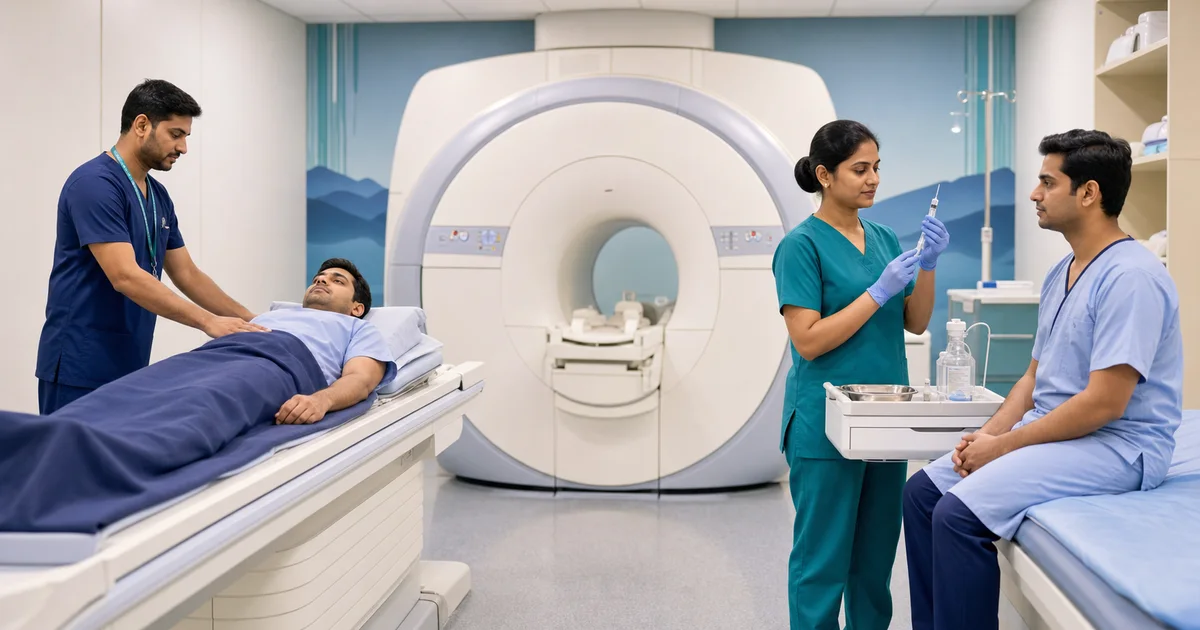
A plain MRI creates detailed images using a strong magnetic field and radio waves without injecting a contrast agent. A contrast MRI involves the administration of a contrast material, commonly a gadolinium-based agent, when additional detail is required.
The decision between Plain MRI vs Contrast MRI depends on the body part, symptoms, medical history and the diagnostic information required by the treating doctor or radiologist. A contrast MRI is not automatically better than a plain MRI; it is useful only when enhancement can provide clinically relevant information.
Quick Answer: Plain MRI vs Contrast MRI
A plain MRI is performed without an intravenous contrast injection. It may provide sufficient information for many examinations involving the brain, spine, joints and other body structures.
A contrast MRI includes an intravenous contrast agent that can help highlight certain tissues, blood vessels, inflammation, abnormal growths or areas with altered blood supply. The appropriate protocol must be selected according to the doctor’s prescription and the imaging centre’s clinical assessment.
Plain MRI vs Contrast MRI Comparison
| Factor | Plain MRI | Contrast MRI |
|---|---|---|
| Contrast injection | Not used | Usually injected through an IV |
| Common contrast agent | Not applicable | Commonly gadolinium-based |
| Purpose | Structural imaging without enhancement | Additional tissue or vascular detail |
| Preparation | Usually limited | Additional screening may be required |
| Kidney assessment | Generally not contrast-related | Kidney-function assessment may be requested |
| Scan duration | Depends on body part and protocol | May take longer for IV placement and additional images |
| Price | Generally lower | Usually higher due to contrast and added procedures |
| Selection | Based on prescription and clinical need | Used when the added information is considered necessary |
What Is a Plain MRI Scan?
A Plain MRI Scan is performed without injecting a contrast agent. The scanner uses a magnetic field, radio waves and computer processing to create detailed images of internal body structures.
Plain MRI may be used for selected examinations of the:
- Brain
- Spine
- Knee
- Shoulder
- Pelvis
- Joints
- Muscles and soft tissues
Whether a plain study is sufficient depends on the medical question the doctor is trying to answer. Patients should not change a prescribed contrast study to a plain scan solely to reduce the price.
What Is an MRI with Contrast?
An MRI with Contrast uses an intravenously administered contrast agent to improve the visibility of selected tissues or structures. MRI contrast agents commonly contain gadolinium and are different from the iodine-based contrast materials commonly associated with CT examinations.
Contrast enhancement may help a radiologist assess differences between tissues or observe blood vessels and patterns of enhancement. It may be considered in selected examinations involving suspected inflammation, vascular conditions, abnormal tissue or follow-up assessment. Contrast should be administered only after an appropriate clinical order, safety screening and patient consent.
Is Contrast MRI Better Than Plain MRI?
Contrast MRI is not universally better than plain MRI. The better examination is the one that appropriately answers the clinical question.
A plain study may provide all the required information for some conditions. In other situations, enhancement may show additional information that is not as clearly visible on non-contrast images. The choice can depend on:
- The body part being examined
- The suspected medical condition
- Previous imaging findings
- History of surgery or treatment
- Kidney health
- Pregnancy status
- Previous contrast reactions
- The radiologist’s protocol
Patients should follow the prescribed protocol and discuss concerns with their doctor or imaging centre.
MRI Contrast Safety
Gadolinium-based MRI contrast agents are used under medical supervision after reviewing the patient’s relevant health information. Allergic-like reactions can occur but are uncommon, and severe reactions are rare.
Patients should inform the MRI team if they have:
- Kidney disease or kidney failure
- A kidney transplant
- Liver disease
- A previous reaction to MRI contrast
- Pregnancy or possible pregnancy
- Multiple previous contrast examinations
- Other significant medical conditions
A rare condition called nephrogenic systemic fibrosis has been associated with gadolinium exposure in some patients with severe kidney disease. Depending on the patient and contrast agent, the centre may request a kidney-function test or decide not to administer contrast.
Who Should Inform the Centre Before Contrast MRI?
Contact the diagnostic centre before the appointment if you have known kidney disease, previous dialysis, a kidney transplant, a previous gadolinium reaction, pregnancy concerns, a pacemaker or implanted medical device, metal fragments, surgical clips, claustrophobia or a possible need for sedation.
Implant and metal-device screening is required for MRI regardless of whether contrast is used.
Is Fasting Required Before a Contrast MRI?
Fasting is not required for every contrast MRI. Eating and drinking instructions vary by body part, protocol, contrast use, sedation requirement and diagnostic-centre policy.
Confirm these points before the appointment:
- Whether fasting is required
- How many hours of fasting are needed
- Whether water is permitted
- Whether routine medicines can be taken
- Whether a kidney-function test is required
- Whether sedation has been planned
Patients should follow the instructions provided for their specific examination rather than assuming a fixed fasting period.
How Should You Prepare for a Plain or Contrast MRI?
Before either type of MRI:
- Carry the doctor’s prescription.
- Carry previous MRI, CT or relevant medical reports.
- Inform the centre about a pacemaker, implant or metal fragment.
- Disclose pregnancy or possible pregnancy.
- Remove jewellery, watches and other metal accessories.
- Inform the centre if you have claustrophobia.
- Follow the centre’s eating, drinking and medicine instructions.
For a contrast study, also disclose kidney problems and previous contrast reactions. Carry a recent creatinine or kidney-function report if the centre has requested one.
How Long Does Plain MRI vs Contrast MRI Take?
MRI duration varies according to the body part, number of sequences, patient movement and scan protocol. Some examinations may take approximately 20–60 minutes, although specialised studies can take longer.
Contrast MRI may require additional time for medical screening, IV-line placement, contrast administration, extra image sequences and observation when clinically required. The diagnostic centre should provide an estimated duration for the prescribed study.
Plain MRI vs Contrast MRI Price
A Contrast MRI Scan generally costs more than a plain MRI because it may include contrast material, IV-line placement, additional imaging sequences and clinical monitoring.
The final MRI Scan Price can vary according to:
- Body part
- Plain or contrast protocol
- Type and amount of contrast agent
- City and diagnostic centre
- Machine capability and scan protocol
- Sedation requirement
- Reporting requirements
Prices displayed online should be treated as indicative. Confirm the final price and inclusions with the selected centre before booking.
How to Book a Plain or Contrast MRI Online
To request an appointment through Online Health Booking:
- Select the prescribed MRI test.
- Specify whether the prescription mentions plain or contrast MRI.
- Share the city and preferred locality.
- Provide the preferred appointment date.
- Share relevant prescription details when requested.
- Review the available centre and indicative price.
- Confirm preparation requirements before the visit.
Do not independently select or remove contrast from the prescribed protocol. Visit the MRI Scan booking page to compare available options or review all diagnostic services.
Final Takeaway
The difference between Plain MRI vs Contrast MRI is the use of an injected contrast agent and the additional information it may provide. Neither option is automatically better for every patient.
Follow the doctor’s prescription, complete MRI safety screening and confirm preparation, contrast requirements and final pricing with the diagnostic centre before booking.
Medical Disclaimer
Online Health Booking provides diagnostic-service information and booking coordination. Website content is for general information and does not replace diagnosis, medical advice, a prescription or consultation with a qualified healthcare professional.
Sources
- RadiologyInfo: MRI preparation and contrast-material safety
- U.S. Food and Drug Administration: MRI benefits and risks
- American College of Radiology: MR safety and contrast-media guidance
Common questions
Frequently Asked Questions
What is the main difference between plain MRI and contrast MRI?+
A plain MRI is performed without an injected contrast agent. A contrast MRI uses a contrast material, commonly gadolinium-based, when additional image enhancement is clinically required.
Is contrast MRI better than plain MRI?+
Not always. Contrast may provide additional information for selected medical questions, while a plain MRI may be sufficient for others. The appropriate protocol should be selected by the prescribing doctor and imaging team.
Is MRI contrast safe?+
MRI contrast is administered after patient screening and under medical supervision. Patients with kidney disease, previous contrast reactions or pregnancy should discuss their circumstances with their doctor and imaging centre.
Is fasting required before contrast MRI?+
Not for every contrast MRI. Requirements vary by examination, facility policy and whether sedation is needed. Follow the instructions given for the prescribed study.
Can a plain MRI be changed to a contrast MRI during the scan?+
In some situations the imaging team may determine that contrast is required, but administration should follow an appropriate clinical order, safety screening and patient consent.
Does contrast MRI take longer?+
It may take longer because IV placement, contrast administration and additional image sequences can be required. Total duration varies by protocol.
Why is contrast MRI more expensive?+
Contrast MRI may include the contrast agent, IV supplies, additional sequences and clinical support. Final pricing depends on the centre and prescribed protocol.
Can contrast MRI be performed during pregnancy?+
Gadolinium contrast is generally avoided during pregnancy unless the clinical benefit is considered necessary. A doctor and radiologist should assess the individual circumstances.